
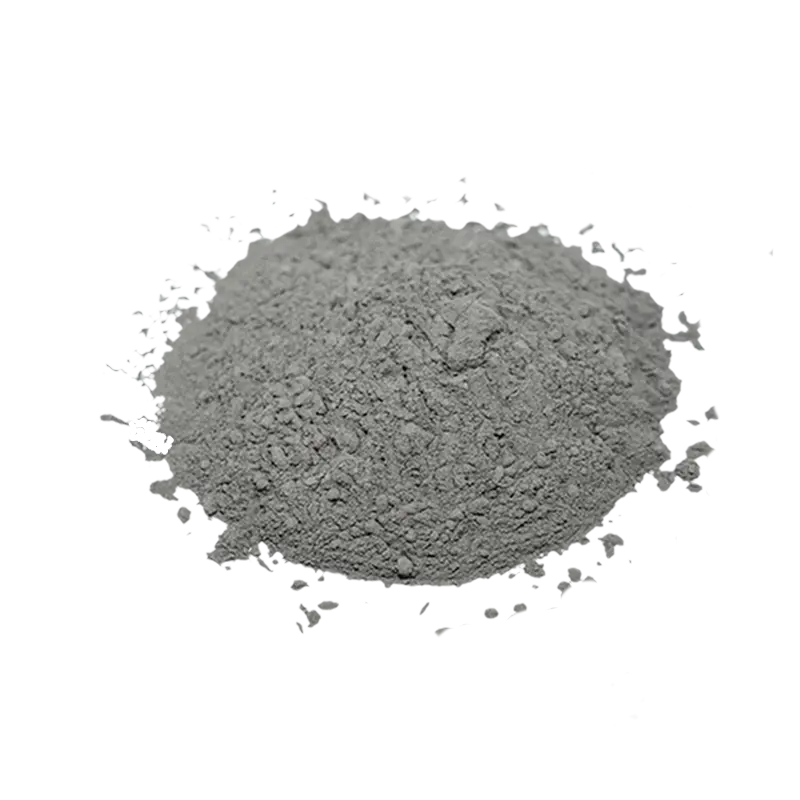
DH-S® Ti64
Titanium powder.
Selected for your process.
KYHE’s recycled Ti-6Al-4V powder is supplied in two particle-size specifications for material selection and process evaluation.
Match chemistry, flow and particle distribution to your MIM or agreed additive-manufacturing route.
Material supply, process support and component projects can be discussed separately.
Details that make
the difference.
Review the full particle-size distribution and physical properties when selecting your powder.
| Property | 0–20 μm | 15–53 μm |
|---|---|---|
| D10 (μm) | 6–8 | 15–25 |
| D50 (μm) | 13–15 | 28–35 |
| D90 (μm) | 20–24 | 42–50 |
| Hall flow rate (s/50 g) | Not specified | ≤45 |
| Apparent density (g/cm³) | ≥2.3 | ≥2.3 |
| Tap density (g/cm³) | ≥2.75 | ≥2.6 |
| Oxygen, O (wt.%) | 0.18 | 0.15 |
| Nitrogen, N (wt.%) | 0.05 | 0.05 |
| Hydrogen, H (wt.%) | 0.03 | 0.03 |
| Circularity | ≥0.9 | ≥0.9 |
Values support initial material selection. O, N and H acceptance limits are agreed in the order specification. Hall flow data is unavailable for the 0–20 μm grade. Circularity describes particle shape in two dimensions. Source: KYHE material data.
From powder properties
to specimen performance.
Typical specimen results depend on processing,
post-treatment and test conditions.
View complete specimen properties
| Property | Typical value |
|---|---|
| Tensile strength | 950 MPa |
| Yield strength | 850 MPa |
| Elongation | 15% |
| Density | 4.35–4.45 g/cm³ |
| Hardness | 350–400 HV |
| SST (salt-spray test duration) | >240 h |
Mechanical and corrosion-test acceptance criteria are agreed for each application.
Compare material properties
| Material / reference | Tensile (MPa) | Yield (MPa) | Elongation (%) | Density (g/cm³) | Hardness (HV) | SST (h) |
|---|---|---|---|---|---|---|
| ASTM F2885-11 reference | 900 | 830 | 10 | 4.35–4.45 | 350 | — |
| MIM 630 (HT) | 1100 | 1000 | 8 | 7.60–7.70 | 320–380 | <8 |
| MIM 316L | 510 | 150 | 50 | 7.85–7.95 | 110–150 | 96 |
| DH-S Ti64 | 950 | 850 | 15 | 4.35–4.45 | 350–400 | >240 |
Source: KYHE material data. Properties vary with alloy, processing conditions and test methods. The ASTM F2885-11 values are included as a reference and do not establish product compliance. This table compares different materials; it does not establish a performance advantage over virgin Ti64 powder.
Prepare your
material evaluation.
Discuss the specification, safety information and batch documents required for your project. Document availability and scope are confirmed with the team.
Before you choose
your powder.
Which particle-size range should I choose?
Start with your manufacturing route and equipment requirements. Review D10, D50 and D90 alongside the nominal size range, then agree the chemistry, flow and acceptance criteria for your process.
Can DH-S Ti64 be used for additive manufacturing?
Suitability depends on the printing process, machine and required part properties. Particle size alone does not establish compatibility. Share your process and equipment so that material selection and validation can be defined.
Do specimen results guarantee the performance of my part?
Typical specimen results support material evaluation. Part geometry, processing, post-treatment and test conditions affect final performance; application-specific acceptance criteria should be agreed before supply.
What should I include in a sample or quotation request?
Include the alloy, particle-size range, quantity, equipment or process, required documents and target delivery date. Sample availability, packaging, lead time and commercial terms are confirmed in the quotation.
How does production cost relate to my quotation?
KYHE reports approximately 60% lower production cost against its conventional powder-production benchmark. This is a production-cost comparison; your material quotation depends on specification, quantity and supply terms.
Tell us what
you’re working on.
Share your material, quantity and process requirements. Our team can discuss supply, evaluation and the next steps for your project.
info@ky-he.com
+86 180 5828 5806